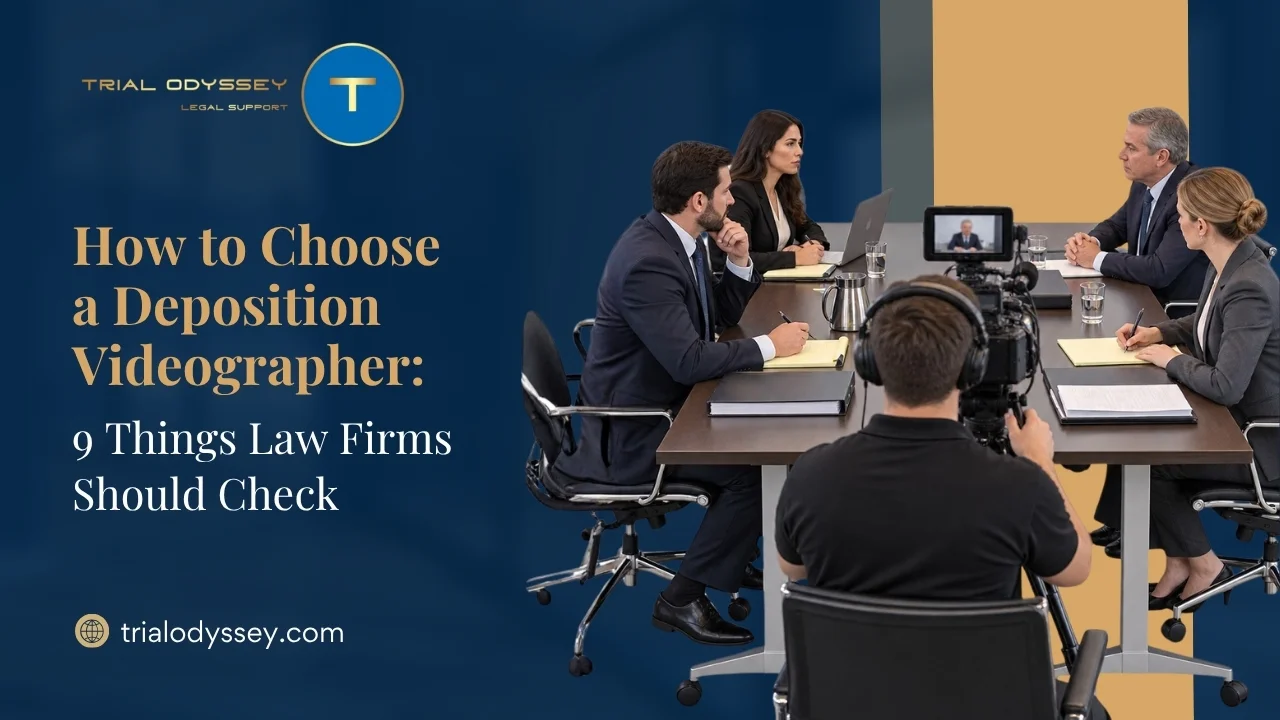
A deposition video is not a keepsake. It is potential trial evidence, and the person behind the camera decides whether it holds up when opposing counsel moves to exclude it. Hiring a deposition videographer on price alone, or on a vague promise of “professional service,” is how firms end up with footage a judge will not let a jury see. The nine checks below separate a qualified legal videographer from someone who owns a good camera.
Most of what ranks online for this search reads the same: generic praise, no specifics. The questions that actually protect the record are narrower and more technical than those pages suggest. Work through them before the notice goes out, not after the deposition is over.
1. The Right Certification, From a Real Issuing Body
Start with credentials, and know which ones mean something. The recognized standard is the Certified Legal Video Specialist (CLVS), administered by the National Court Reporters Association, which requires a mandatory workshop, a written knowledge test, and a hands-on production exam at a staged deposition. The American Guild of Court Videographers offers a parallel track, including its Certified Deposition Video Specialist credential built around Federal Rules of Civil Procedure 28, 30, and 32.
The caution matters as much as the credential. Some outfits advertise “certified” videographers using certificates from pay-to-play bodies with no hands-on evaluation and no standing anyone recognizes. Verify the issuing organization. NCRA and AGCV are legitimate; a certificate from an organization no court has heard of is marketing, not qualification.
2. Whether They Can Administer the Oath in Your State
This is the check that quietly sinks video evidence, and almost no buyer’s guide mentions it. In some states, the videographer or the officer present must be authorized to administer the oath for the recording to be admissible. California is a notable example: when videotaping a treating physician or expert witness, the videographer generally needs authority to swear the witness, which usually means notary public credentials.
Do not assume. Ask the videographer, for the specific state where the deposition sits, whether they or the court reporter can properly put the witness under oath on the record. A recording of unsworn testimony is a recording of nothing usable.
3. Command of FRCP 30 On-the-Record Procedure
Federal Rule of Civil Procedure 30 governs how a recorded deposition has to run, and the details are not optional. The deposition notice must state the recording method. The officer has to open on the record with a set sequence of statements, repeat identifying statements at the start of each recording unit, and close the same way. The rule also caps a deposition at one day of seven hours unless the parties or the court agree otherwise, and it requires that the deponent’s appearance not be distorted through camera tricks or framing.
A videographer who knows this cold runs the room without prompting. One who does not will hand you a record with procedural holes that opposing counsel is trained to find.
4. A Redundant Signal Chain
Ask a blunt technical question: what happens when a microphone dies twenty minutes into testimony? The right answer involves backup. A serious deposition videographer runs a redundant capture setup, a secondary recorder and spare audio, so a single equipment failure does not destroy an afternoon of testimony that cannot be re-created. Clear audio is not a nicety here. If the jury cannot hear a crucial answer, that answer effectively did not happen.
5. Real Remote and Hybrid Capability
Remote and hybrid depositions are routine now, and they are harder to get right than in-person ones. A capable videographer can capture a clean, synchronized, court-ready record when the witness is in one city, counsel in another, and the reporter somewhere else, without the recording dissolving into frozen frames and dropped audio. Ask specifically how they handle a remote deponent, what platform and connection redundancy they use, and how the remote record is preserved to the same standard as an in-room one.
6. Transcript Synchronization
Video and transcript have to line up. Synchronized deposition video, where the text scrolls against the footage, is what lets a trial team pull an impeachment clip in seconds rather than scrubbing through hours of recording. Confirm the videographer delivers a synced product, or works cleanly with the court reporter to produce one. A trial team that has to hunt for the moment a witness contradicted themselves will find it too late.
7. Chain of Custody and Secure Delivery
Video evidence has to survive an authentication challenge, which means the deposition videographer must be able to show an unbroken chain of custody from capture to delivery. Ask how the files are handled, stored, and transmitted, and whether delivery is secure rather than a link emailed from a personal account. The officer’s certification that accompanies the recording is part of what makes it self-authenticating under the evidence rules, so it has to be produced correctly every time.
8. Neutrality and No Disqualifying Interest
The videographer is an officer of the record, not a member of your team, and that distinction protects the evidence. Professional standards require the videographer to remain neutral to all parties and to have no financial or personal interest in the case. It sounds obvious until a firm tries to save money by using someone connected to the matter, and hands the other side an easy argument that the record was compromised. Independence is a feature, not a formality.
9. Legal Fluency, Not Just Camera Skills
The last check is the hardest to fake. A deposition videographer who understands legal terminology, deposition protocol, and admissibility standards operates as part of the proceeding. One who treats it like a corporate shoot misses cues, mishandles exhibits on camera, and creates small errors that add up to a vulnerable record. Experience in the legal setting specifically, not videography in general, is what you are paying for.
What This Actually Comes Down To
Choosing a deposition videographer is a risk decision disguised as a vendor decision. The wrong pick does not announce itself on the day; it surfaces months later when a motion to exclude lands and the record cannot answer it. Run these nine checks and most of that risk disappears before the witness is sworn. Trial Odyssey handles legal videography with these standards built in, so the record a firm captures today is one it can still rely on the day it matters in court.
Frequently Asked Questions
1.Does the law require a certified legal videographer?
No state actually requires CLVS certification. But some judges ask whether the videographer is certified, and for testimony that could reach a jury, certification is cheap insurance against a challenged record.
2.What does CLVS certification actually prove?
That the videographer passed a workshop, a written test, and a hands-on production exam through the National Court Reporters Association, covering deposition protocol, chain of custody, and the officer’s certification.
3.Can a standard videographer record a deposition?
They can operate the camera, but they usually don’t know FRCP 30 procedure, the on-the-record statements, or admissibility standards. A polished recording that violates protocol is still inadmissible.
4.How do I know a certification is legitimate?
Verify the issuing body. NCRA and AGCV are recognized and testable. Certificates from pay-to-play organizations no court has heard of are marketing, not qualification.
5.Should the deposition video be synchronized with the transcript?
Yes. Synced video, where the text scrolls against the footage, lets a trial team pull an impeachment clip in seconds instead of scrubbing through hours of recording. Confirm the videographer delivers a synced product or works cleanly with the court reporter to produce one.