The courtroom is where the trial happens. The war room is where the trial is run. It is the off-site command center, usually a hotel suite or leased office near the courthouse, where the team strategizes at night, prepares witnesses, rebuilds tomorrow’s exhibits, and makes the decisions that the next day in court will test. Get the war room logistics right and the whole trial operates from a position of control. Get them wrong and the team spends the trial reacting.
This is not the same as courtroom setup, and the distinction is worth holding. Courtroom setup is about the well of the court: the monitors, the presentation system, the evidence camera. The war room is the base of operations behind it. Both matter, but they solve different problems, and a team that plans one and neglects the other walks in half-ready.
Location Is the First Decision
Before anything goes into the room, the room itself has to be chosen well. Proximity to the courthouse is the single most valuable feature. A war room within walking distance turns a mid-day recess into a working session; one across town turns it into lost time. The surrounding area matters almost as much: lodging for the team, food, and the office-supply and print resources a trial burns through. When travel budgets or geography make a single physical space impractical, the modern answer is a hybrid war room that blends an in-person hub with reliable remote inclusion, so the team can flex as who-needs-to-be-where shifts day to day.
Zoning the Room for How Trials Actually Work
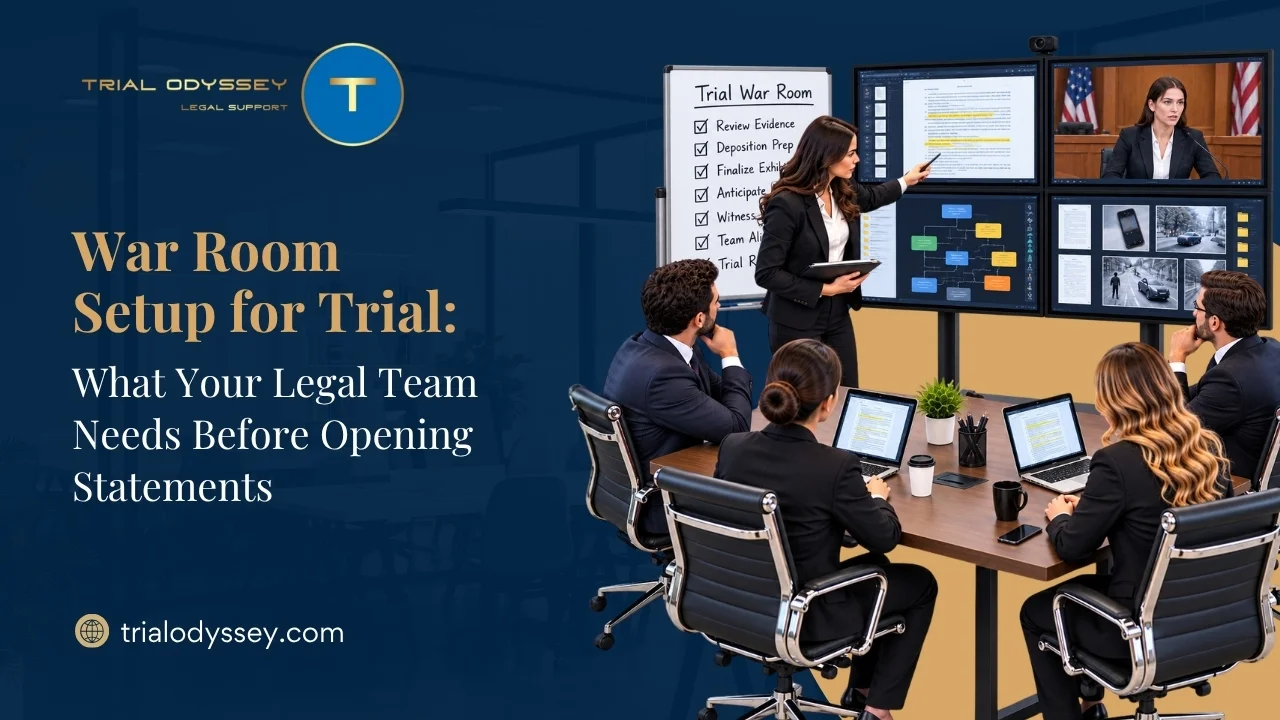
The best war room logistics come down to zoning, giving each recurring activity its own defined space instead of one undifferentiated room. A strategy zone with a large table and mobile whiteboards, where decisions get made. A quiet, private zone for witness preparation and sensitive calls, screened from the general bustle, because witness prep in a crowded room is neither effective nor discreet. And an exhibit-and-tech zone, where version control lives and materials move through a visible workflow, in progress, reviewed, ready for court, so nothing ambiguous ends up in front of a judge.
That last board is deceptively important. A shared, physical view of what is ready and what is not prevents the single most common war-room failure: two people working from two different versions of the same exhibit.
The Infrastructure Layer
Sound war room logistics depend on the systems inside the room. That means a secure network, wired and wireless, built to the firm’s security standards rather than borrowed hotel Wi-Fi, since case material cannot ride an open connection. It means workstations, high-capacity printing and copying, and lockable storage for exhibits and confidential files. Power gets underestimated constantly; a room full of laptops, monitors, and copiers needs far more capacity and far more cable management than a standard office, and discovering that at 9 p.m. before opening statements is the wrong time.
Redundancy and the Scale Problem
Two realities shape smart war room logistics. First, trial dates are fixed and last-minute changes are constant, so the setup has to absorb surprises: a spare configured laptop, backups of every critical file, and enough slack in the plan that one failure is a footnote. Second, a war room is temporary. Headcount can spike fast, then the whole thing has to come down cleanly when the verdict is in. Buying furniture and gear for a short surge creates its own storage headache, which is why firms increasingly rent the room’s contents and scale down without inventory left over. Trial Odyssey builds war rooms with both realities in mind, standing up the space and its systems for the length of the trial and breaking them down after, so the firm carries none of the aftermath.
Ready Before Day One
A war room is not a luxury for big cases; it is the operating system of any serious trial, the place the team turns a long day in court into a plan for the next one. Handle the location, zone the space for real work, secure the infrastructure, and build in the redundancy that fixed trial dates demand. Do that and the team walks into opening statements with a command center already humming behind it. Trial Odyssey sets up and runs war rooms to exactly that standard, so the space works as hard as the people in it, and stays on through the trial to keep it that way.
Frequently Asked Questions
1.What is a trial war room?
The off-site command center, usually a hotel suite or leased office near the courthouse, where the team strategizes at night, prepares witnesses, rebuilds exhibits, and plans the next day in court.
2.How close to the courthouse should the war room be?
As close as possible. A war room within walking distance turns a recess into a working session, while one across town turns it into lost time.
3.How should a war room be organized?
By zones: a strategy space, a private zone for witness prep and sensitive calls, and an exhibit-and-tech zone with a visible in-progress, reviewed, ready workflow so no ambiguous version reaches the judge.
4.Should we rent or buy war room equipment?
Rent, in most cases. A war room is temporary and headcount spikes then vanishes, so renting avoids owning gear you have to store after the verdict.
5.Can we just use hotel Wi-Fi for the war room?
No. Case material can’t ride an open, shared connection. A war room needs a secure network, wired and wireless, built to the firm’s own security standards, which is a core part of standing the room up rather than an afterthought.