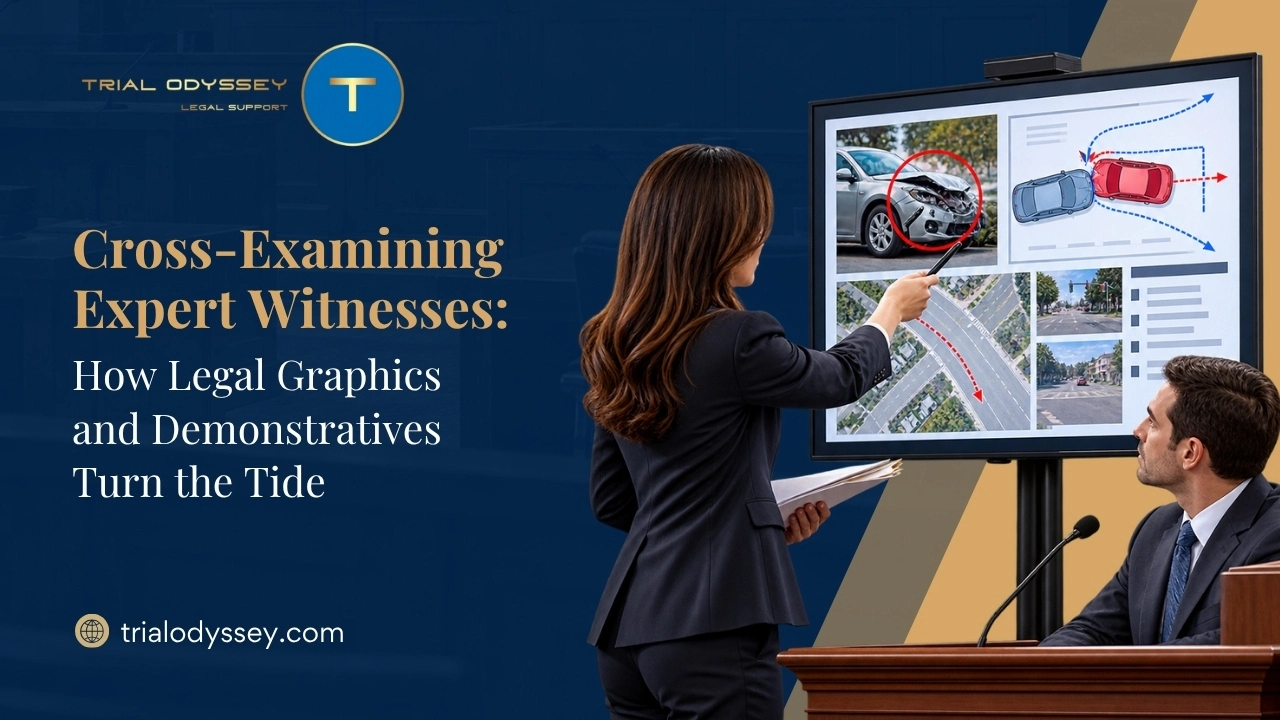
An opposing expert walks into cross-examination with every advantage. The science is theirs. The vocabulary is theirs. And if the exchange stays purely verbal, they can drift into the technical weeds where they have spent a career and you have spent a few months, and the jury watches a specialist calmly explain why you are wrong. That is the fight you lose. Legal graphics and demonstratives are how you change the ground it is fought on.
The move is not to build a flashier visual than the expert’s. It is to make the expert’s own weakness something the jury can see rather than something they have to follow. Done right, a single image moves the contest from “who knows more,” where the expert wins, to “what is in front of us,” where you do.
Why Experts Are Hard to Cross, and What a Visual Changes
The core problem with expert cross is asymmetry. The witness understands the subject better than anyone in the room, including you, so a question-and-answer duel on the merits plays to their strength. Push too hard on the science and you hand them an open microphone to re-explain their direct testimony in more detail.
A visual breaks the asymmetry because it does not argue with the expert. It shows the jury something they can judge for themselves. A timeline, a side-by-side, a single highlighted line from the expert’s own report does not require the jury to referee a technical dispute. It lets them see the contradiction and draw the obvious conclusion. The expert can keep talking, but the image has already made the point, and talking over it tends to make the witness look evasive.
Turn the Expert’s Own Materials Against Them
The highest-value cross graphics are the ones you do not have to defend, and that means using the expert’s own words. When the visual is a blowup of their report set beside a conflicting line from their deposition, there is no foundation fight and no argument about whether your graphic is fair. It is theirs. You are only displaying it.
The rules reward this directly. Federal Rule of Evidence 613 lets you impeach a witness with a prior inconsistent statement, and a synced video clip of the expert saying the opposite at deposition is far harder to explain away than a lawyer reading a transcript. Keep the rule’s requirement in view: for extrinsic proof, the witness has to get an opportunity to explain or deny, so build the moment to accommodate that rather than ambush it. A clean report-versus-deposition comparison, or the expert’s own chart pulled apart on screen, is the kind of courtroom graphic that wins a cross without the lawyer ever raising their voice.
Expose the Buried Assumption
Most expert opinions rest on an assumption the expert would rather not spotlight. Federal Rule of Evidence 705 gives you the tool to drag it into the light: an expert may be required to disclose the underlying facts or data on cross-examination, even if they never mentioned them on direct.
The verbal version of this almost never lands. You ask what the opinion assumes, the expert gives a long technical answer, and the jury loses the thread. The visual version is ruthless. Isolate the single load-bearing assumption on one slide, show that it is not supported by anything in the record, and the jury sees a conclusion standing on nothing. The graphic does in one image what three minutes of questioning cannot, which is make an invisible methodology flaw visible. This is where well-built demonstratives earn their place, and where a team like Trial Odyssey spends its time, finding the one assumption worth isolating and building the frame that exposes it.
Put the Treatise on the Screen
When the literature contradicts the expert, the learned treatise is a precise weapon. Under Federal Rule of Evidence 803(18), a passage from a text established as a reliable authority, by the expert’s own admission, by your expert, or by judicial notice, can be used against the witness on cross. Get the expert to concede the source is authoritative, then put the contradicting passage on the screen next to their opinion.
One rule shapes how you use it. The treatise may be read into evidence but not received as an exhibit, so it does not go back to the jury room, and the whole volume never comes in. Display only the passage that matters, keep it brief, and let the contrast do the work. A long reading loses the jury; one authoritative sentence against the expert’s contrary view does not.
The Admissibility Angle Most Lawyers Miss
Here is the part that has changed, and that most cross strategy has not caught up to. The December 2023 amendment to Federal Rule of Evidence 702 tightened the gate on expert testimony. The party offering the expert now has to show the reliability requirements are met more likely than not, the judge decides that question rather than the jury, and the court must find that the opinion reflects a reliable application of the methods to the facts of the case, not just a sound method in the abstract.
That reshapes what your graphics are for. A demonstrative that exposes the gap between the expert’s method and their conclusion is no longer only a persuasion tool aimed at the jury. It is support for a motion aimed at the judge. The same side-by-side that would deflate the expert in front of the jury can help argue, before trial, that the opinion should not reach the jury at all. Legal graphics and demonstratives built for cross now do double duty, and the firms that understand that are using the same visual twice.
Where Visuals Backfire
The honest counterpoint matters, because a visual on cross can turn on you. Your demonstratives still need foundation and still face a Rule 403 objection, so a graphic that overstates or distorts gets excluded or, worse, gets corrected by the expert in front of the jury, handing them a win. The witness knows the material better than you do, and a clumsy visual gives them something to dismantle. The discipline is restraint: one clean contradiction beats a cluttered montage, and the simplest true image is the hardest to escape. A partner like Trial Odyssey is often worth as much for the visuals it talks a trial team out of as for the ones it builds.
Make the Weakness Visible
Cross-examining an expert is not about beating them at their own subject, which rarely works, but about showing the jury the one place the opinion does not hold. Legal graphics and demonstratives are the fastest way to make that place visible, and the strongest of them are built from the expert’s own report, deposition, and data, governed by the rules that decide how each one comes in. Find the single weakness, frame it in the expert’s own words, and put it where the jury cannot miss it. That is the image that turns the tide, and it is the one worth building before you ever stand up to cross.
Frequently Asked Questions
1.How do graphics help when cross-examining an expert?
They shift the contest from a technical argument, which the expert wins, to something the jury can see and judge directly. A side-by-side or a highlighted contradiction makes the point without debating the expert on their own ground.
2.What is the most effective cross-examination visual?
Usually the expert’s own material. A blowup of their report next to a conflicting deposition line, or a synced video clip of that prior statement, needs no defending and is hard for the witness to explain away.
3.Can demonstratives used in cross be excluded?
Yes. They still require foundation and face a Rule 403 objection for being misleading or unfairly prejudicial. A distorted or overbuilt graphic can be kept out or corrected by the expert, so accuracy and restraint matter.
4.How does the 2023 FRE 702 amendment affect this?
It put the reliability burden on the party offering the expert, made the judge the gatekeeper, and requires a reliable application of methods to the facts. A graphic that exposes a method-to-conclusion gap now supports a pretrial admissibility motion, not just jury persuasion.
5.Can a learned treatise be shown to the jury as an exhibit?
No. Under Rule 803(18) the passage may be read into evidence but not received as an exhibit, and it does not go to the jury room. Display only the relevant portion on screen.