
A law firm spends years hardening its office network. Then trial comes, and the whole team decamps to a hotel suite or a leased office near the courthouse, carrying the most sensitive material in the case, and rebuilds its entire security setup from scratch in a weekend. That is the problem in one sentence. The war room concentrates privileged data at the exact moment the firm’s defenses are improvised, temporary, and run by people who are litigators, not security engineers.
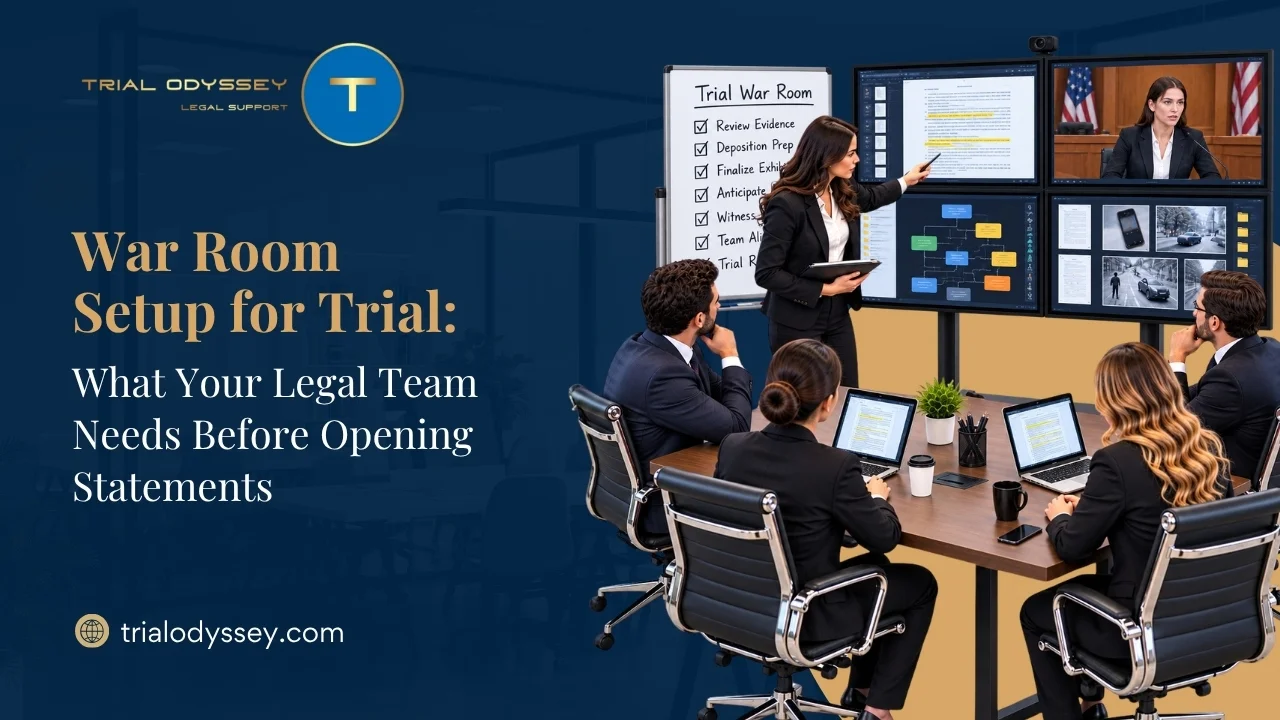
Litigation cybersecurity usually gets treated as an IT line item. It is not. It is an ethical duty with the firm’s name on it, and in a trial war room it is the duty most easily dropped. Proper physical and digital planning-much like what is outlined in a comprehensive war room setup for trial guide-is essential from day one.
This Is an Ethics Obligation, Not a Preference
Start with what the rules actually require. Model Rule of Professional Conduct 1.6(c) directs every lawyer to “make reasonable efforts to prevent the inadvertent or unauthorized disclosure of, or unauthorized access to” client information. Rule 1.1, Comment 8 folds technology into basic competence: a lawyer has to keep abreast of the benefits and risks of the tools the practice runs on.
The standard is not perfection. ABA Formal Opinion 477R is clear that “reasonable efforts” has no hard and fast rule; it is a process of weighing risk against safeguards. But the opinion also lists the factors that decide how much security a given matter demands, and the first one is the sensitivity of the information. Trial material sits at the top of that scale. A war room holds case strategy, privileged communications, work product, and exhibits that have not yet been shown to anyone. Apply the opinion’s own test and the conclusion is blunt: this data earns the high end of the effort.
Why the War Room Is the Weak Point
The office is defended. The war room is assembled. That difference is the whole risk.
Temporary sites run on whatever connectivity is available, and the default option is the worst one: open hotel or convention Wi-Fi that any guest can join. Personal laptops appear because someone needed to finish a demonstrative at 2 a.m. Printed exhibits and binders stack up on tables, the one breach no system logs. Temporary staff and vendors get broad access because vetting takes time nobody has. None of this is negligence. It is what happens when a secure environment has to exist by Monday.
The attackers know where the soft layer is, and it is human. The FBI warned U.S. law firms in 2025 about a group tracked as Luna Moth, also called the Silent Ransomware Group. Their method is not a clever exploit. They call an employee, pose as the firm’s own IT help desk, and talk the person into granting remote access, then steal the data and demand between one and eight million dollars. Baker Hostetler’s incident response team reported that law-firm-targeted incidents nearly doubled from 2024 to 2025.
When coordinating equipment, high-speed connectivity, and hardware rentals on short notice, ensuring secure channels is just as critical as sourcing courtroom equipment rentals.
A Breach Can Cost You the Privilege
Here is the exposure that almost no security checklist mentions, and it is the one that should get a litigator’s attention. A breach is not only a confidentiality failure. It can become an evidentiary one.
Federal Rule of Evidence 502(b) protects privileged material from waiver when disclosure is inadvertent, but only if the holder “took reasonable steps to prevent disclosure” and acted promptly to fix it. A cyber intrusion that spills privileged files is an unauthorized disclosure. If the firm then has to argue the privilege was not waived, it is arguing from the condition in 502(b)(2), the reasonable-steps requirement, and a war room secured with hotel Wi-Fi and unvetted access is a poor place to make that argument from. The security lapse and the privilege fight are the same lapse. Protecting the data protects the admissibility of everything that touches it.
Your Vendor Is Your Responsibility
Many firms hand the war room to an outside litigation-support provider, which is sensible. It does not transfer the duty. Model Rule 5.3 makes the lawyer responsible for taking reasonable steps to ensure a nonlawyer’s conduct is compatible with the lawyer’s own obligations. One ethics authority put it plainly: an attorney cannot blindly trust an outside vendor with client information.
So the choice of partner is itself a security control. Before the data moves, confirm the vendor encrypts it, stands up a dedicated secure network rather than borrowing the building’s, binds its own staff to confidentiality in writing, and returns or destroys the material when the trial ends. This is the standard Trial Odyssey is built to meet through our specialized war room setup and management services, because a provider that cannot answer those questions is not saving the firm risk, it is adding it. Utilizing professional on-site network and IT support guarantees that your temporary office meets enterprise-grade specifications.
What a Secure War Room Actually Requires
Reasonable effort, translated into a setup you can demand:
- Multi-factor authentication on every account that touches case data. Microsoft’s own data, cited by the ABA, puts MFA’s effectiveness against credential attacks at 99.9 percent, and only 54 percent of firms have it switched on.
- Encryption at rest and in transit, full-disk on every device that leaves the office.
- A dedicated, firewalled network built for the war room. Never shared Wi-Fi. A secure cellular hotspot beats a hotel connection every time.
- Access on a need-to-have basis, not blanket access for everyone in the room.
- Physical security the digital plan tends to forget: lockable storage for devices and exhibits, a clean-desk habit, and shredding.
- An incident response plan that travels to the trial site. Only about a third of firms have one at all, and a plan sitting on the office server does nothing in a hotel at midnight.
- Social-engineering training for the whole team, temporary staff included, because Luna Moth is a phone call.
Trial Odyssey builds its war rooms around these controls so the firm is not reconstructing a security perimeter under deadline and hoping it holds. You can read more about planning your timeline in our guide on the complete trial preparation timeline.
After a Breach, the Clock Starts and the Client Is Waiting
If something does get through, ABA Formal Opinion 483 sets the sequence. Act promptly to stop the breach and figure out what was taken. Then, under Rule 1.4, notify the affected client when material confidential information was involved or is substantially likely to have been. During trial, that means telling your client their case data was exposed while their case is being tried. There is no good time for that conversation, but there is a worse way to have it, which is late and with nothing solid to report.
Decide It Before the Data Moves
Litigation cybersecurity is not a reaction to an incident. It is a set of decisions made before the first box leaves the office, graded later against a standard the rules already wrote down. The firms that come through a trial without a breach are not the lucky ones. Trial Odyssey have been handling cases like these for clients with proven results for so many years. They are the ones who treated the war room as part of the security perimeter from the start, and who chose a partner that did the same. The time to settle how the data is protected is the day it moves, not the day the call comes in.
Frequently Asked Questions
1.Is war room data security actually an ethics requirement? Yes. Model Rule 1.6(c) requires reasonable efforts to prevent unauthorized access to client information, and ABA Formal Opinion 477R ties the required effort to the sensitivity of the data. Trial material is high-sensitivity, so it calls for strong safeguards.
2.Can a data breach affect attorney-client privilege? It can. Under Federal Rule of Evidence 502(b), privilege survives an inadvertent disclosure only if reasonable steps were taken to prevent it. A poorly secured war room weakens that position, turning a security lapse into a potential waiver.
3.If we hire a litigation support vendor, is the security their problem? No. Model Rule 5.3 keeps the responsibility with the lawyer. Vetting the vendor’s encryption, network, and confidentiality terms is part of meeting your own duty.
4.What is the biggest war room vulnerability? The human layer. The 2025 FBI warning about Luna Moth involved attackers impersonating IT help desks by phone. Open hotel Wi-Fi and unvetted access make it worse.
5.Do we have to tell the client if a breach happens during trial? Generally yes. ABA Formal Opinion 483 and Rule 1.4 require notifying a current client when a breach involves or is substantially likely to involve their material confidential information.