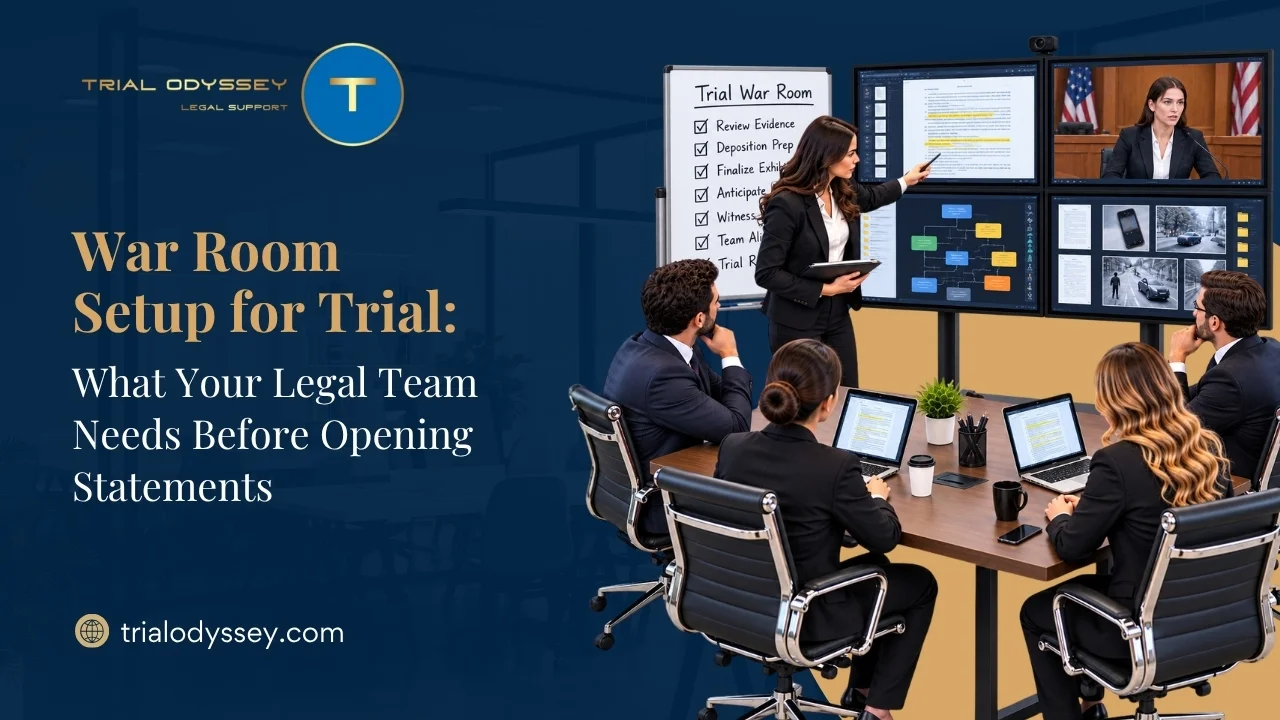

Trials do not respect business hours. A judge moves the date up by a week. A key exhibit surfaces the night before it is needed. The presentation laptop dies at 6 a.m. on the morning of opening statements. A witness’s testimony shifts and tomorrow’s demonstratives have to be rebuilt overnight. These are not edge cases; they are the ordinary texture of trial, and they are exactly why round-the-clock trial support services exist. The question a firm should ask is not whether plans will change. It is who will be awake when they do.
This is a narrower promise than general trial support. It is about the surge moments, the nights and weekends and sudden reversals, when the gap between having help on call and not having it decides whether a problem becomes a crisis.
Why Last-Minute Is the Norm, Not the Exception
Trial schedules are fixed on paper and fluid in practice. Judges reset dates to clear a docket. Rulings on motions in limine land late and reshape what can be shown. Settlement talks collapse on a Friday and a matter everyone expected to resolve is suddenly going to trial Monday. The common thread is compression: the work does not shrink, but the time to do it does, and it lands outside the hours when a nine-to-five vendor is reachable. A firm relying on daytime-only support discovers the limit at the worst possible moment.
What 24/7 Actually Means in Practice
Round-the-clock trial support services are not a phone line that goes to voicemail. In practice the capability shows up in a few concrete forms. It is an overnight demonstrative rebuild, when testimony changed the story and the opening graphic has to change with it before 9 a.m. It is emergency equipment replacement, a failed monitor or presentation system swapped out on a few hours’ notice rather than a few days’. It is a hot-seat operator or technician who can be on-site fast when the firm’s plan for running the courtroom falls through. And it is real support during the trial day itself, so a mid-testimony technical failure gets fixed in minutes instead of derailing an afternoon.
The value is not the drama of the rescue. It is that the firm never has to gamble that nothing will go wrong.
The Venue-Change Scenario
Consider the hardest common case: the trial moves, or the firm is trying a matter somewhere it has never worked. Now the team faces unfamiliar local rules, a courtroom whose technology it has not seen, electronics restrictions it has not checked, and evidence-submission requirements, formats, deadlines, and systems like a court’s jury evidence platform, that it cannot learn on the morning of trial. Trial support services with reach across jurisdictions absorb that shock, because someone on the team already knows the venue. Local knowledge, available on short notice, is one of the most valuable things a firm can have when the ground shifts.
Building the Safety Net Before You Need It
The mistake firms make is treating emergency support as something to find during the emergency. By then the options are bad. The teams that handle last-minute changes well are the ones that engaged their trial support services before trial, so the relationship, the equipment inventory, and the firm’s specific setup are already known when the 2 a.m. call comes. A partner brought in early can respond instantly; a stranger cold-called at midnight cannot. Trial Odyssey structures its support around exactly this, staying reachable and ready through the trial so the firm has a known number to call when the plan changes.
The Point of Round-the-Clock Support
Last-minute changes are not a failure of planning; they are what trials do. The firms that stay calm through them are not luckier, they are covered. Round-the-clock trial support services turn the predictable chaos of a trial, the moved dates, the dead equipment, the overnight rebuilds, into managed events rather than emergencies. Trial Odyssey provides that coverage so that whenever the plan changes, and it will, the response is already in place and the trial keeps moving. When the stakes are a verdict, that readiness is not a convenience. It is the difference between a stumble and a fall.
Frequently Asked Questions
1.What counts as emergency trial support?
Overnight demonstrative rebuilds after testimony shifts, emergency equipment replacement, a hot-seat operator on short notice, and real-time fixes during the trial day, the surge moments outside normal hours.
2.What happens if my trial date moves or changes venue?
A provider with reach across jurisdictions absorbs the shock, because someone already knows the venue’s local rules, courtroom technology, and evidence-submission requirements you can’t learn on the morning of trial.
3.Should 24/7 support be arranged before trial?
Yes. The teams that handle last-minute changes well engage support in advance, so the relationship and equipment are known when the 2 a.m. call comes. A stranger cold-called at midnight can’t respond the same way.
4.Are last-minute changes really that common?
Yes. Fixed dates get reset, motions land late, and settlements collapse on a Friday. Compression is the ordinary texture of trial, not a rare failure.
5.How fast can emergency trial support actually respond?
A partner engaged before trial can respond almost immediately, because your equipment, setup, and preferences are already known. A failed monitor or presentation system gets swapped in hours rather than days, and a mid-testimony glitch is fixed in minutes instead of derailing the afternoon. A stranger cold-called at midnight can’t move that fast.