The Question That Gets Asked Every Year
Every time a new piece of trial technology appears, someone asks whether physical binders are finally finished. Every year, the answer turns out to be the same.
Walk into any active trial in any federal or state court in the country and count the binders on the counsel table. The number will surprise you if you expected digital to have taken over by now. According to U.S. Legal Support’s 2025 litigation survey, only about 27.9 percent of firms managed all trial technology in-house in 2024, down from 32.7 percent the previous year. But the decline in in-house technology management has not translated into a decline in physical binders. It has translated into firms outsourcing the production of both.
Outsourcing Has Increased, Not Binder Usage Declined
There is a reason for this. Physical binders, properly created, do something that no trial presentation software fully replicates. They give an attorney a tangible, instantly accessible, non-dependent piece of the case in their hands at the moment they need it.
The ABA’s 2024 Legal Technology Survey found that laptop usage in courtrooms has jumped to 74 percent of court practitioners, up from 50 percent in 2018. And yet binders have not disappeared alongside paper. They have survived precisely because they solve a different problem than technology solves.
What a Well-Built Trial Binder Actually Does
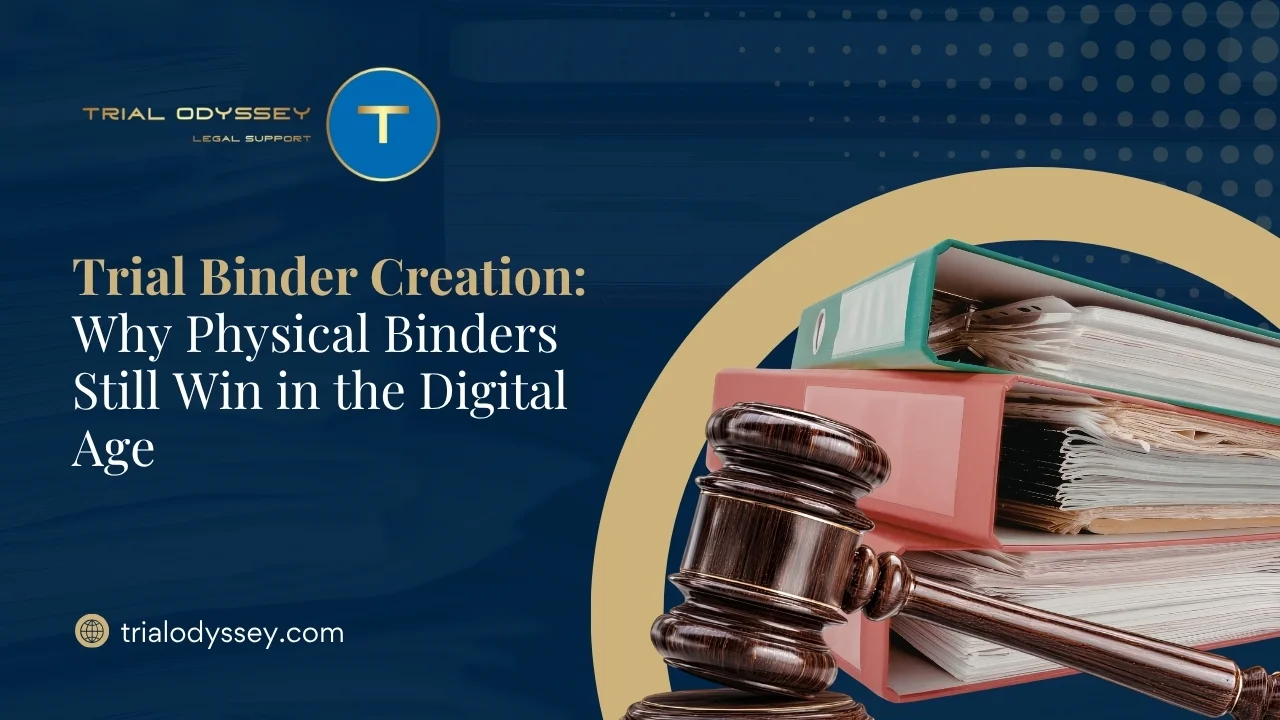
A trial binder is not a filing system. That distinction matters.
A filing system organizes documents for retrieval. A trial binder organizes information for action. The purpose is to give the attorney what they need at the exact moment they need it during a proceeding that does not pause for searching, loading, or technical troubleshooting.
As Sam Davidoff, former litigation partner at Williams and Connolly, has noted, binders are modular, portable, agile, and personal. They let you bury yourself in what is critical to the task at hand. They let you customize with handwriting, highlighting, and tabs in ways that reflect how you actually think about the case, not how a software interface organizes documents.
Why Attorneys Still Prefer Physical Organization
A trial binder also does not run out of power. It does not freeze. It does not require a network connection. It does not go blank if someone touches the wrong key. In a courtroom where you cannot afford a five-minute delay while a laptop reboots, those are not trivial advantages.
What Goes Into a Properly Created Trial Binder
The Structure
The most effective trial binders are organized around the trial itself, not around the case file. That sounds obvious but it is a distinction that separates binders that work from binders that become another thing to manage under pressure.
The structure should follow the natural progression of the proceeding: voir dire, opening statement, direct examinations organized by witness, cross-examination materials, exhibits organized by the order they will be introduced, closing argument. Each section has a clear entry point. The attorney should be able to flip to what they need without searching.
A table of contents in the front is not optional. In a complex case with multiple binders, a master index showing which binder contains which section becomes equally important.
The Content
At a minimum, a trial binder contains witness outlines or examination scripts, exhibit lists, key exhibits tabbed for immediate reference, a case chronology, and any legal standards or jury instructions relevant to the claims being tried.
In complex cases, separate binders by witness, by subject matter, or by day of trial often serve better than one unwieldy volume. The rule of thumb is that no single binder should be so thick that it cannot sit open flat at the podium while the attorney is on their feet.
Binder Size and Usability
Every binder should be produced with durable construction. Standard office binders fail under the repeated handling of a multiday trial. D-ring binders hold more pages and keep them flatter. Reinforced spines survive the abuse of being opened and closed hundreds of times. Cover sheets identifying each binder at a glance prevent the wrong volume from being grabbed at the wrong moment.
Multiple Copies
The judge gets a set. Opposing counsel gets a set. The court reporter may need one. Witnesses may require copies of exhibits they will be examining. The attorney needs their own working copy and a clean backup.
Each copy needs to be identical. A discrepancy between the attorney’s exhibit list and the copy the judge is working from is the kind of small error that creates large disruptions.
Where Trial Odyssey Fits In
Trial binder creation is detailed, time-consuming, and deadline-driven. It peaks at exactly the moment when every member of the trial team is also at their most stretched.
Trial Odyssey handles binder production as part of comprehensive trial support, managing the physical organization, printing, tabbing, and delivery of binders built to the exact specifications of the legal team. The work is done to professional standards and on the timeline the case requires, including early mornings and late nights in the final push to trial.
Built to Legal Team Specifications
The binder that is ready when the attorney walks into court is the binder that was built carefully, built early, and built by people who understand what it needs to do.
Trial Odyssey’s 24/7 print production and same-day turnaround capability means that last-minute changes to witness order, exhibit lists, or examination outlines do not leave the team working with outdated materials. The binder reflects the current state of the case, not the state it was in three days before trial.