
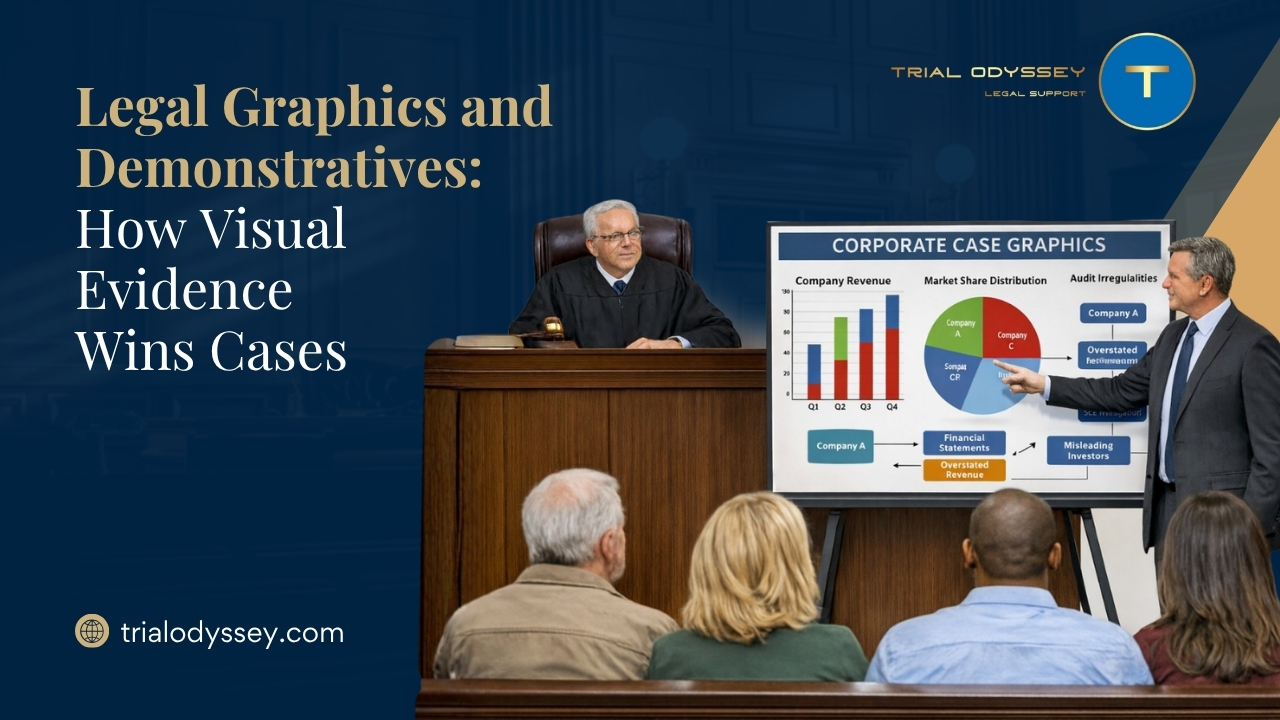
What Jurors Actually Remember
A study cited across the trial advocacy community has put the number at 65 percent. That is how much information people retain when it is presented visually alongside verbal explanation. Present the same information through audio or text alone, and retention drops to roughly 10 percent three days later.
For trial attorneys, that gap is the difference between a jury that understands your case and a jury that does not.
Why Visual Processing Matters in Court
Courts are not lecture halls. Jurors come with varying levels of education, different professional backgrounds, and no particular reason to find a complex commercial dispute or a technical patent claim easy to follow. What they have in common is a deeply human tendency to understand the world through pictures, patterns, and stories. Legal graphics and demonstratives exist to meet that tendency where it is.
According to U.S. Legal Support’s 2025 Trial Readiness survey, 37 percent of firms now use a legal graphics partner for demonstratives and animations, and 41 percent have conducted a mock trial or focus group prior to going to trial. Visual strategy is no longer a premium option. It is the baseline expectation.
What Legal Graphics Actually Are
The terminology matters because courts treat different visual materials differently.
Demonstrative Evidence Explained
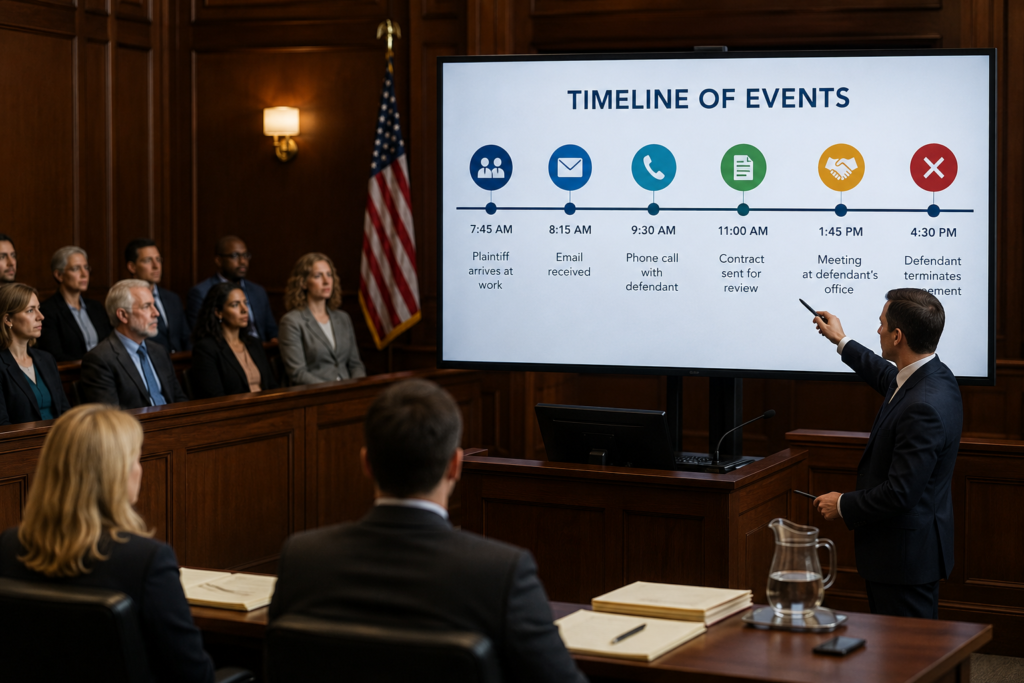
Demonstrative evidence, sometimes called illustrative aids, is material that helps the jury or judge understand testimony or admitted evidence. It does not itself prove a fact in dispute. A timeline showing the sequence of events, a diagram of an accident scene, a chart comparing financial figures: these are demonstratives. They are used to clarify and organize information that has already come into the record.
Substantive evidence, on the other hand, is material offered to prove something. A photograph of the scene taken immediately after the accident. An original contract. A security video. These go into evidence and the jury can take them into the deliberation room.
The distinction matters practically. Federal Rule of Evidence 107, which took effect on December 1, 2024, now specifically governs illustrative aids. Under Rule 107(a), a party may use an illustrative aid only where its utility in assisting comprehension is not substantially outweighed by the danger of unfair prejudice, confusing the issues, misleading the jury, undue delay, or wasting time.
Under Rule 107(b), an illustrative aid must not be provided to the jury during deliberations unless all parties consent or the court orders otherwise for good cause. The Sixth Circuit in United States v. Baskerville, 164 F.4th 459 (6th Cir. 2026), observed that although Rule 107 now expressly governs illustrative aids, the governing standard remains materially the same as prior practice, clarifying terminology and procedures rather than introducing entirely new doctrine. Courts in California apply their own standards under the Evidence Code.
Knowing which category your visual falls into shapes how you introduce it, how opposing counsel can object to it, and what the jury can do with it during deliberations.
The Types of Legal Graphics That Move Cases
Timelines
Timelines are among the most consistently effective demonstratives in litigation. They give the jury a shared framework before testimony begins. In a contract dispute, a fraud case, or any matter where the sequence of events is itself contested, a well-constructed timeline lets jurors track what happened and when without having to reconstruct it themselves from dozens of individual exhibits.
The most effective timelines are not exhaustive. They highlight the moments that matter and leave space for the jury to absorb them.
Accident Reconstructions and Scene Diagrams
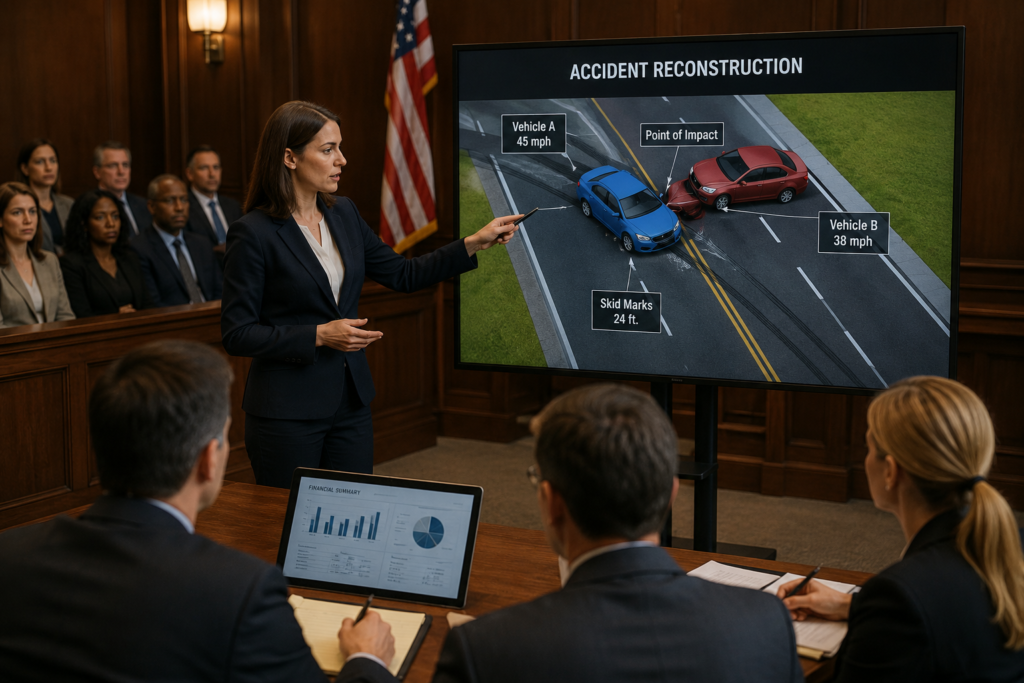
In personal injury, wrongful death, and product liability cases, the physical reality of what happened often cannot be understood from documents alone. Scene diagrams show relationships between positions, distances, and sight lines. Accident reconstructions, whether static or animated, show how the event unfolded in space and time.
These visuals are particularly powerful because they replace abstraction with something concrete. A witness can testify that the defendant’s vehicle was traveling at an excessive speed at the time of impact. A properly constructed animation shows what that actually looked like from multiple perspectives.
Medical Illustrations and Anatomical Graphics
Medical cases present some of the most significant comprehension challenges in litigation. A jury of laypersons is being asked to evaluate complex anatomical and physiological claims that trained physicians spend years learning to understand.
Medical illustrations drawn or rendered with clinical accuracy, enhanced medical scan imagery, and animations showing how an injury progressed or how a surgical procedure was performed give jurors a foundation for evaluating expert testimony that written reports alone cannot provide.
Financial and Data Charts
In commercial litigation, securities fraud cases, and damages calculations, the numbers involved are often large, the relationships between figures are not immediately obvious, and the opposing expert will have their own interpretation ready. A clear chart or diagram that shows the financial picture your way, grounded in the admitted evidence, gives the jury something to hold onto through days of competing testimony.
Under Rule 1006, amended concurrently with the adoption of Rule 107, summaries admitted to prove the content of voluminous admissible evidence are now expressly governed as substantive evidence rather than illustrative aids. The distinction shapes both how financial summaries are introduced and how opposing counsel can challenge them.
Where Graphics Are Used Beyond the Courtroom
Many trial teams use demonstratives first in mediation and arbitration, before any jury ever sees them. A compelling visual presentation of liability and damages can drive settlement outcomes at mediation in ways that a verbal description cannot.
Demonstratives in Mediation and Arbitration
Graphics developed for settlement often need only modest adjustment for trial use, which means the investment pays returns at multiple stages of the case.
Trial Odyssey develops legal graphics and demonstratives for trial teams from early case assessment through courtroom presentation, working closely with attorneys and expert witnesses to ensure every visual is grounded in the evidentiary record and built to withstand scrutiny. The goal is not to make something that looks impressive. It is to make something that is clear, accurate, and persuasive, which is a more demanding standard than it might appear.
The Trial Odyssey graphics team works from the case theory outward, not from a design template inward. That distinction produces visuals that carry the argument rather than decorating it, which is the standard that holds up when opposing counsel challenges the aid under Rule 107’s balancing test.
The Practical Side: Timing and Collaboration
Legal graphics are not something to commission the week before trial. The most effective demonstratives emerge from a collaborative process that begins with understanding the case themes, identifying where juror comprehension is most likely to fail, and developing visuals that address those specific gaps.
That process takes time. Revisions are part of it. An attorney may present the first version of a timeline to a focus group and discover that what seemed obvious to someone who has spent two years in the case is genuinely unclear to someone encountering it fresh. The graphic then gets refined.
Starting early also means you have the flexibility to iterate. Starting late means you take what you get and hope it works.