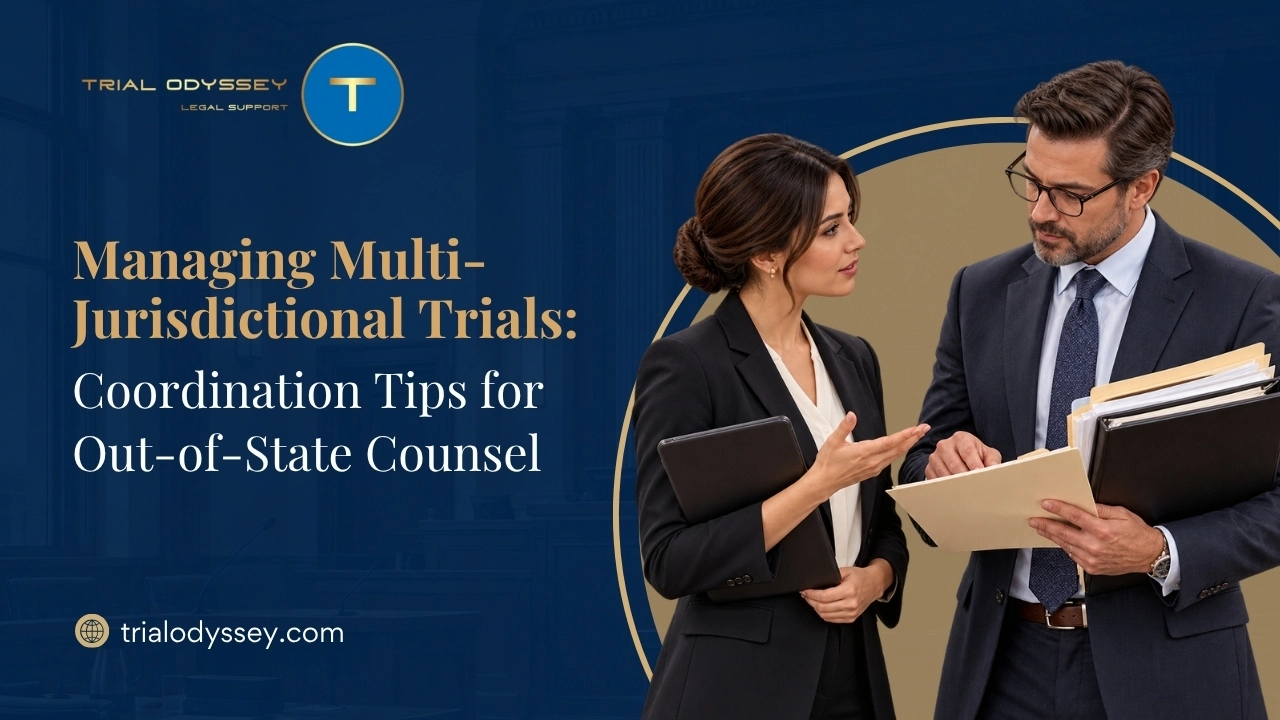
Trying a case where you are not admitted means rebuilding three things at the same time: the authority to stand up in that courtroom, a working knowledge of rules you have never used, and an operation in a city you do not know. Any one of them can sink the trial before opening statements, and they all come due at once. The team that treats a multi-jurisdictional trial as its usual trial in a different zip code is the team that gets ambushed by a rule it never read.
Good out-of-state trial support is what keeps those three from failing together. It is a coordination problem more than a lawyering problem, and the firms that win away from home are the ones who solve it in the weeks before trial rather than the week of.
First, the Authority to Appear
Start with the thing that lets you in the door. Pro hac vice admission, Latin for “for this occasion only,” gives an out-of-state lawyer permission to appear in one specific case. It is not general practice, and it is not automatic. The motion runs through local counsel, usually with a certificate of good standing and a statement of no discipline, and the judge decides. A judge can deny it, and a judge can revoke it mid-case for misconduct. Some states also cap how many times a lawyer can appear this way in a year. Treat it as a privilege the court grants, not a form you file.
The quieter risk sits in the work you do before admission comes through. A law license is tied to the state that issued it, and practicing where you are not licensed can be unauthorized practice. This is not a theoretical worry. In Birbrower v. Superior Court, out-of-state lawyers who worked a matter in a state where they were not admitted saw their entire fee agreement voided and recovered nothing. The ethics rules carve out safe harbors for temporary practice tied to a case where you expect to be admitted, so map your pre-trial work to one of them rather than assuming the trial admission covers everything that came before it.
Local Counsel Is Not a Mail Drop
The most common mistake out-of-state teams make is treating local counsel as a formality, a name on the caption who files the papers and stays out of the way. That view is wrong twice over.
It is wrong ethically, first. Local counsel cannot act as a mail drop or messenger; bar authorities have said so directly. They remain counsel of record, sign filings under a personal certification of reasonable inquiry, and stay responsible to the client for the conduct of the case before that court, however limited their agreed role. A local lawyer who signs off on work they never reviewed is exposed, and so are you.
It is wrong strategically, second, and this is the part that costs cases. Local counsel is your single best source on how that court actually works, the judge’s temperament, the customs no rule book records, the way things are really done in that building. A firm that sidelines local counsel throws away its most valuable asset in the venue to save a few conversations. Use them for what they are, which is your guide, not your clerk.
The Real Trap Is the Local Local Rules
Here is where out-of-state counsel get hurt, and it is almost never the published rules. Every district has its own local rules, and finding them is easy. On top of those sit each judge’s standing orders and chambers preferences, what one practitioner aptly calls the “local, local rules,” and those are where the ambush lives.
The variation is not trivial. Depending on the district, the conference of counsel might be due forty days before the final pretrial conference, or twenty-one, or there may be no exchange requirement at all. One district requires that your trial exhibit numbers match the deposition exhibit numbers. Several judges demand competing verdict forms, complete with a redline of the disputed language. A theory you leave out of the final pretrial order can be barred at trial. Attorney voir dire ranges from twenty minutes to none. Some judges forbid writing on the ELMO, some do not allow sidebars, and most require you to argue from the lectern. None of this is in the federal rules. All of it can derail a lawyer who prepared for the district and never checked the judge. The instruction is simple: verify the judge, not just the court.
The Ground Game
The authority and the rules are only two layers. The third is the operation, and it is the one most likely to steal time you cannot spare. An out-of-state trial means standing up a war room in an unfamiliar city, arranging courtroom technology you have not seen, finding local vendors you have never used, and moving exhibits and equipment across the country on a fixed trial date. A team that lands and starts learning the courthouse on the morning of trial has already lost ground to the other side.
This is the layer where a venue-savvy support partner changes the math. Reliable out-of-state trial support means someone who already knows that courthouse, its technology, its restrictions, and its local resources, so lead counsel can spend the days before trial on the case instead of on logistics. Trial Odyssey builds its support around exactly this problem, handling the ground game in unfamiliar venues so the trial team arrives ready to work rather than ready to improvise.
Build the Coordination Map Before You Travel
A multi-jurisdictional trial runs on a clear division of labor, settled early. Lead counsel owns strategy and the courtroom. Local counsel owns local law, filing, and the judge’s customs. A support partner owns the logistics, the technology, and the war room. Write down who owns what before anyone books a flight, because the failures in these trials are almost always seams, a task everyone assumed someone else had. A firm that maps the coordination in advance, with Trial Odyssey carrying the operational layer, walks into the venue as a single team rather than three groups meeting at the courthouse.
When the Full Apparatus Is Overkill
The honest counterpoint belongs here. Not every out-of-state matter needs all of this. A straightforward case in a neighboring district a short drive away, before a court whose practices are close to your own, may need little more than competent local counsel and a careful read of the rules. The apparatus scales with distance, size, and stakes. A two-day hearing one state over is not an eight-week trial across the country, and spending as though it were is its own kind of mistake. Match the coordination to the matter, and let the hard cases get the full treatment they actually require.
Set the Coordination Before the Week Of
Winning a trial away from home is less about brilliance in the courtroom than about the three layers being handled before you get there. Secure the authority and keep it clean, treat local counsel as the guide they are, verify the judge’s own rules rather than just the district’s, and put the operational weight on a partner who knows the venue. Out-of-state trial support is a planning exercise, and the teams that do the planning are the ones who try a case in a strange courthouse as though it were their own. Trial Odyssey exists to carry that load, so the only unfamiliar thing on trial day is the jury.
Frequently Asked Questions
1.What is pro hac vice admission?
It is permission for an out-of-state lawyer to appear in one specific case where they are not licensed. It runs through local counsel, the judge decides, and it can be denied or revoked. It is not general authority to practice in the state.
2.Can out-of-state work before admission be a problem?
Yes. Practicing where you are not licensed can be unauthorized practice. In Birbrower v. Superior Court, lawyers lost their entire fee over it. Map pre-trial work to a temporary-practice safe harbor rather than assuming trial admission covers it.
3.Can local counsel just be a name on the filings?
No. Bar authorities say local counsel cannot be a mail drop. They remain counsel of record, certify filings, and stay responsible for the case before the court. They are also your best guide to the judge and local customs.
4.What trips up out-of-state counsel most?
The judge’s standing orders, not the published local rules. Exhibit numbering, verdict forms, voir dire limits, ELMO and sidebar practices, and pretrial order requirements vary by judge. Verify the judge, not just the district.
5.What does out-of-state trial support actually cover?
The operational layer: war room setup in an unfamiliar city, courtroom technology, local vendors, and moving exhibits and equipment to the venue, so lead counsel can focus on the case rather than the logistics.