Trials are won in the months before anyone stands to give an opening. The work that decides them, locking the theory, preparing the witnesses, building and clearing the exhibits, is spread across a countdown that punishes teams who start late. A disciplined trial preparation timeline turns that countdown from a source of panic into a sequence of manageable deadlines, each one clearing the way for the next.
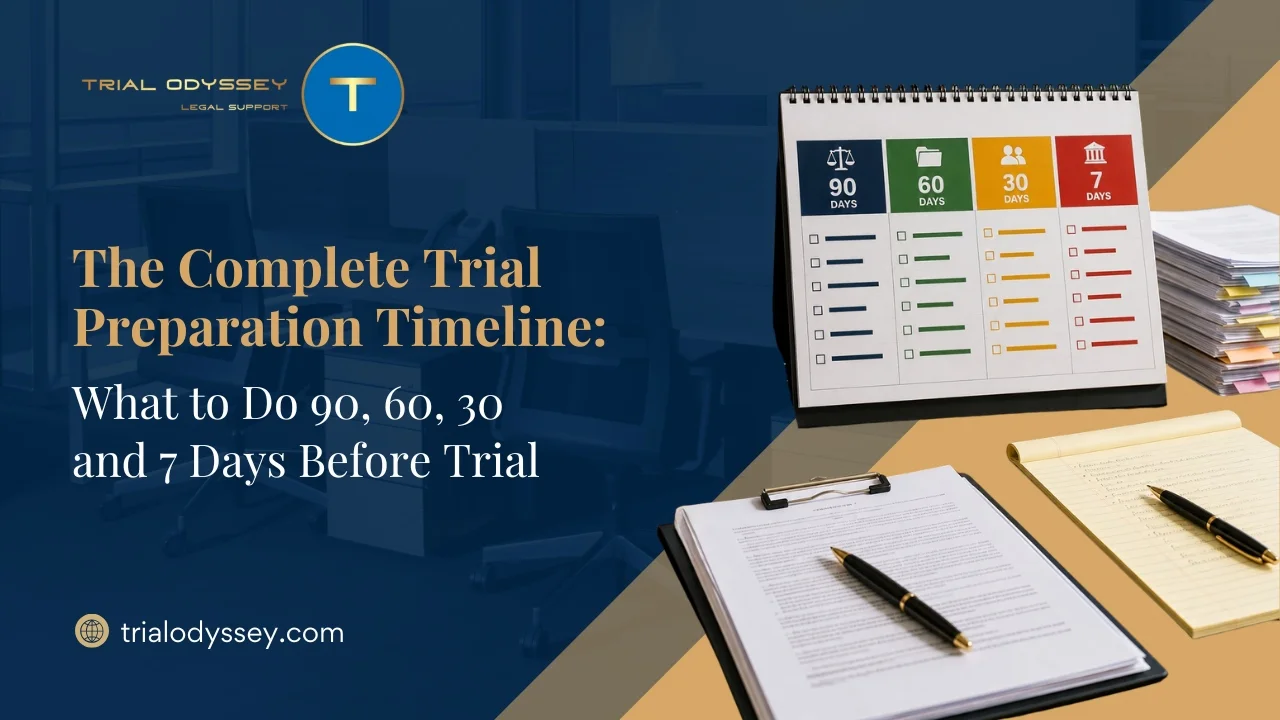
The schedule below marks the four checkpoints that matter most: ninety days out, sixty, thirty, and the final week. The dates on this trial preparation timeline are not arbitrary. One of them is fixed by the Federal Rules, and the rest are shaped by how long the real work actually takes. What follows assumes a complex civil matter, though the logic scales with the case.
90 Days Out: Lock the Strategy
Three months from trial is when the case stops being a file and starts becoming a presentation. The single most important task here is settling the theory of the case, the one-sentence story the whole trial will serve. Everything downstream, exhibits, witness order, demonstratives, flows from that decision, which is why making it late forces expensive rework.
With the theory set, the team should close out remaining discovery, confirm expert disclosures are complete, and build the first version of the master exhibit list. That list is not a week-of task. Started at ninety days, it has time to mature as exhibits are added, cut, and renumbered. This is also the moment to plan demonstratives, because trial graphics carry long lead times and a rushed animation looks rushed. Firms that will need outside help should engage it now rather than in the final scramble.
A trial support partner such as Trial Odyssey brought in at ninety days learns the case alongside the team; the same partner handed a box of exhibits the week before trial cannot. If the venue is unfamiliar or out of state, ninety days is when to learn its local rules and courtroom technology, not the morning of jury selection.
60 Days Out: Build and Pressure-Test
At two months, preparation shifts from planning to production. Direct and cross examinations move from outlines to drafts. Witness preparation sessions get scheduled and begin, and they have to stay on the right side of the ethical line: preparing a witness to testify clearly is required, while supplying facts or scripting answers crosses into coaching that ABA Formal Opinion 508 and Model Rule 3.4(b) prohibit.
Exhibit and graphics work intensifies. Demonstratives get built and checked against their evidentiary category, since a summary offered as substantive proof under Federal Rule of Evidence 1006 is treated differently from an illustrative aid, which since the December 2024 amendments falls under the new Rule 107.
The exhibit list firms up, with a single numbering convention locked so nothing has to be renumbered later. On the motion front, sixty days is the window to draft motions in limine and to prepare proposed jury instructions and voir dire, all governed by the court’s scheduling order rather than a universal clock. Logistics belong here too: reserve the war room, arrange lodging for an out-of-town trial, and order daily transcript service if the case warrants it.
30 Days Out: The Disclosure Wall
Thirty days is the one milestone on this trial preparation timeline that the rules fix for you, and missing it has consequences. Under Federal Rule of Civil Procedure 26(a)(3), a party must serve its pretrial disclosures, the witnesses it will call, the deposition testimony it will use, and every document or exhibit it expects to offer or may offer, at least 30 days before trial. Opposing counsel then has 14 days to object, and any objection not raised in that window, apart from relevance under Rules 402 and 403, is waived unless the court excuses it for good cause. The exhibit list stops being an internal document at this point and becomes a formal disclosure that fixes rights.
The month before trial is dense. The final pretrial conference typically lands in this stretch, and with it the pretrial order that will govern the trial. Motions in limine get argued. Opening demonstratives should be finalized and shared with the court and opposing counsel now, so objections are resolved outside the jury’s presence rather than mid-sentence.
This is also when to confirm courtroom technology and schedule the practice time many courts require, and to check the file formats, size limits, and submission deadline the courtroom deputy sets for any jury evidence system such as JERS. Witness preparation runs hardest here, close enough to trial that the sessions stay fresh in the witness’s mind.
7 Days Out: Final Assembly and Contingency
The last week is not for new work. It is for making sure everything built over the previous three months actually functions together under pressure. Trial binders get assembled for the judge, the witnesses, and counsel, and every digital file is reconciled against its physical counterpart so the version on the screen, the version in the binder, and the version in the witness’s hands are identical.
The presentation system gets loaded and tested, ideally in the actual courtroom, with redundancy built in behind it: a second configured laptop, exhibits stored in two places, and printed copies of the key exhibits and the opening in case every screen goes dark. Roles get assigned and rehearsed so nothing is improvised on day one. One person runs the hot seat, one owns the master exhibit list, one is the point of contact with the courtroom deputy. This is the stage where a partner like Trial Odyssey earns its place, holding the war room, the technology, and the physical-to-digital parity together while counsel gives the opening its final polish. Confirm the JERS files are submitted, confirm the demonstratives are cleared, and stop. A team that has followed the timeline should spend the last weekend rehearsing, not building.
The Countdown Rewards Discipline
No single task on a trial preparation timeline wins a case. But the timeline as a whole is what lets a team walk into court with the theory sharp, the witnesses ready, the exhibits clean, and the technology tested, instead of trading sleep for a scramble the jury can sense. The firms that try cases well are rarely the ones working hardest in the final week.
They are the ones who started at ninety days and let the schedule do its work. Trial Odyssey builds its support around that same discipline, so that whatever the timeline calls for, from the first exhibit list to the last night before opening, the operational load is handled and the case gets the attention it deserves.
Frequently Asked Question
1. Why is a trial preparation timeline important?
A trial preparation timeline helps legal teams organise key tasks well before trial, including witness preparation, exhibit management, courtroom logistics, and pretrial disclosures. Following a structured timeline reduces last-minute issues and allows the team to focus on trial strategy rather than administrative tasks.
2. What should legal teams focus on 90 days before trial?
Approximately 90 days before trial, legal teams should finalise the case theory, complete outstanding discovery, begin building the master exhibit list, plan demonstrative exhibits, review local courtroom requirements, and engage any external trial support providers if needed.
3. What are the key trial preparation tasks 30 days before trial?
Thirty days before trial is typically the deadline for serving pretrial disclosures under the Federal Rules of Civil Procedure. During this stage, legal teams should finalise witness and exhibit lists, prepare opening demonstratives, confirm courtroom technology arrangements, and complete intensive witness preparation.
4. What should be completed during the final week before trial?
The final week should focus on testing courtroom technology, assembling trial binders, verifying physical and digital exhibits, assigning courtroom responsibilities, confirming approved demonstratives, and rehearsing presentations. It is generally not the stage to begin major new preparation tasks.
5. When should a law firm engage a trial support provider?
A trial support provider is most effective when engaged early in the trial preparation process, ideally several months before trial. Early involvement allows the support team to become familiar with the case, assist with exhibit management, courtroom technology, and logistics, and help ensure a smoother trial presentation.