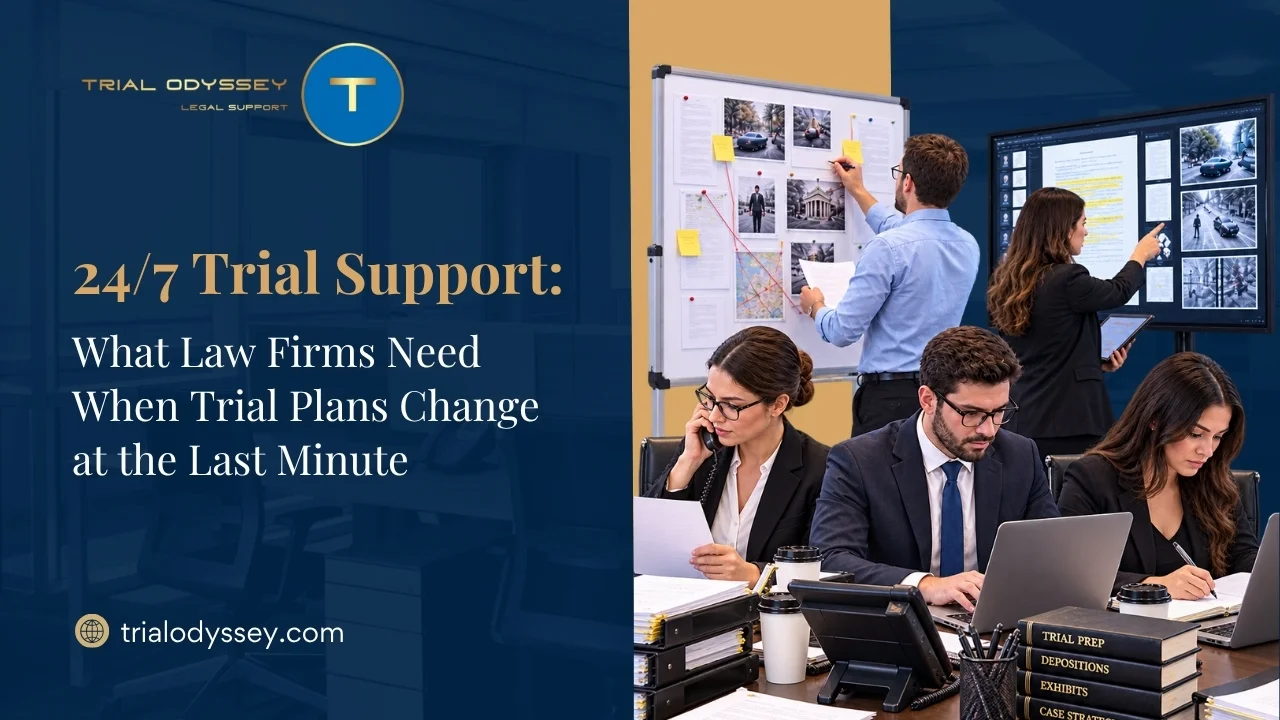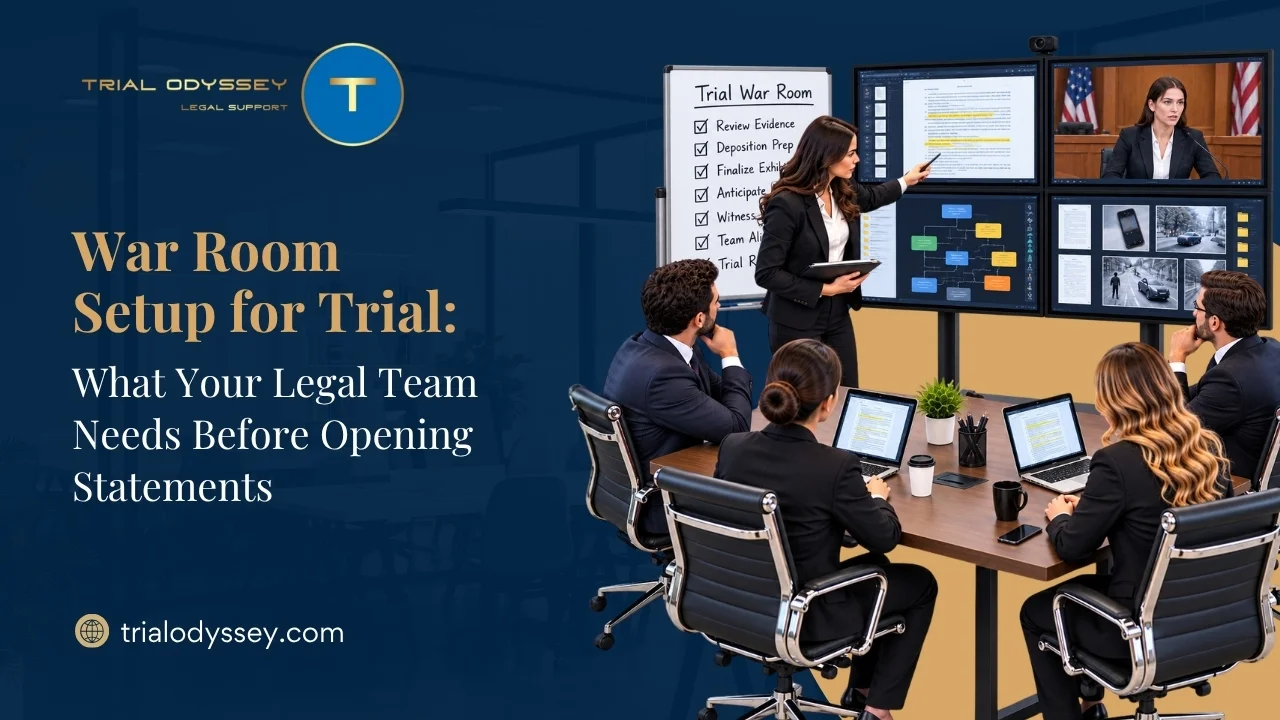

Most firms do not need a permanent trial support department. They need serious trial support a handful of times a year, at unpredictable intervals, under intense pressure, and then not again for months. That mismatch, between steady overhead and episodic demand, is the whole reason the question of when to outsource trial support comes up at all. The honest version of the question is not whether outside help works. It is when bringing it in beats trying to build the capability in-house.
Getting that timing right saves money and, more to the point, keeps the trial team focused on the case instead of the cables. Getting it wrong means either paying for a capability that sits idle or walking into a courtroom under-resourced. The signs below tell a firm which situation it is actually in.
The Real Question Is Utilization, Not Capability
Any firm can hire a trial technologist. The question is whether it should. A full-time in-house trial presentation specialist runs roughly $70,000 to $100,000 a year in salary alone before benefits and overhead, and considerably more in major markets, where senior hot-seat operators command well into six figures. That math only works if the firm tries enough complex cases to keep that person busy across the whole year.
Very few firms do. Trials cluster and then vanish. A litigation boutique might have three matters reach a courtroom in one quarter and none in the next two. Paying a fixed salary against that kind of demand curve is how firms end up with an expensive specialist reformatting slides between trials. Outsourcing converts that fixed cost into a per-matter one.
A partner like Trial Odyssey exists precisely to absorb that variable demand, so the firm pays for trial support when a trial is happening and nothing when it is not, which is the shape the real demand takes. That single reframe, from can we build this to whether we will use it enough to justify it, answers the question of whether to outsource trial support in most cases before the specific signs even come into play.
The Signs a Team Needs Help
Cost logic sets the default. Specific situations force the decision to outsource trial support, and a few recur often enough to treat as reliable signals.
The clearest is scale beyond experience. When a matter arrives with tens of thousands of exhibits, a multi-week schedule, or three parties running competing presentations, and the team has never handled a trial that size, the gap will not close through effort. That is the moment to bring in people who run trials of that scale routinely.
An unfamiliar venue is another. A firm trying a case out of state, or in a federal courtroom it has never worked in, faces local rules, electronics restrictions, and evidence systems like JERS that it cannot learn on the morning of opening statements. Local knowledge is worth buying.
Watch the paralegals, too. When senior case staff are pulling all-nighters building exhibit binders and fighting presentation software instead of preparing witnesses and sharpening the argument, the firm is spending its most valuable people on its lowest-value work. Outsourcing solves that staffing problem directly.
Two more signals deserve attention. A recent courtroom technology failure, or a near-miss the team was lucky to survive, is a warning that should not be ignored twice. And overlapping trials, two matters reaching a courtroom in the same window, will stretch any in-house team past the point where both can be covered well.
What Outsourcing Actually Buys, and When It Does Not
Bringing in an outside team such as Trial Odyssey buys three things a fixed hire rarely provides: surge capacity for the busy stretches, familiarity with venues and courtroom technology across jurisdictions, and redundancy, so a single illness or equipment failure does not take down the presentation. Above all, it buys the trial team its own attention back.
The most common objection to a plan to outsource trial support is that an outside team will not know the case well enough to be useful. In practice, that worry answers itself with timing. A trial support partner brought in during preparation, not the week before opening statements, learns the exhibits, the theory, and the witnesses alongside the trial team and arrives in court already fluent in the matter. The mistake firms make is outsourcing late, handing a vendor a box of exhibits on a Friday and expecting courtroom command by Monday. Engaged early, an outside team functions as an extension of the firm rather than a stranger in the room.
Outsourcing is not the answer to every matter, and pretending otherwise would be dishonest. A short, document-light bench trial in a firm’s home courthouse, tried by a team that knows the room, rarely justifies outside trial support. The goal is not to outsource on reflex. It is to match the resource to the matter, and to see that a bet-the-company case with a courtroom full of exhibits is a very different animal from a two-day hearing down the hall.
Making the Call
The decision comes down to a short set of questions. Does the firm try enough cases to keep a trial technologist genuinely busy? Does this specific matter exceed what the in-house team has handled before? Is it in an unfamiliar venue, running against a compressed schedule, or colliding with another trial? A single yes on the case-specific questions is usually enough to justify outside help for that matter, whatever the firm’s general practice.
Firms that treat the choice to outsource trial support as a case-by-case judgment, rather than a permanent yes or no, tend to spend less and walk into court better prepared. Trial Odyssey is built for exactly that model, stepping in when a matter calls for it and scaling back when it does not, so the capability is there the moment it earns its cost.
Frequently Asked Questions
1. When should a law firm outsource trial support?
A law firm should consider outsourcing trial support when a case involves large volumes of exhibits, complex courtroom technology, unfamiliar venues, overlapping trial schedules, or demands that exceed the capacity of its in-house team. Outsourcing can also be appropriate when trial support needs are infrequent and do not justify maintaining a full-time specialist.
2. What are the benefits of outsourcing trial support?
Outsourcing trial support provides access to experienced trial professionals, courtroom technology expertise, surge capacity during complex litigation, and operational redundancy. It also allows attorneys and paralegals to focus on case strategy, witness preparation, and advocacy rather than managing trial logistics.
3. Is it more cost-effective to outsource trial support than hire an in-house specialist?
For many law firms, outsourcing can be more cost-effective because trial activity is often unpredictable. Rather than maintaining a full-time trial support department that may be underutilised, firms can access specialised support only when a particular matter requires it.
4. What types of cases benefit most from outsourced trial support?
Outsourced trial support is particularly valuable for complex commercial litigation, multi-week trials, matters involving extensive documentary evidence, cases in unfamiliar courtrooms, and situations where multiple trials overlap or require significant courtroom technology and exhibit management.
5. How early should a law firm engage a trial support provider?
Trial support is most effective when brought into a matter during the preparation stage rather than immediately before trial. Early involvement allows the support team to become familiar with the exhibits, witnesses, case strategy, and courtroom requirements, helping ensure a smoother trial presentation.