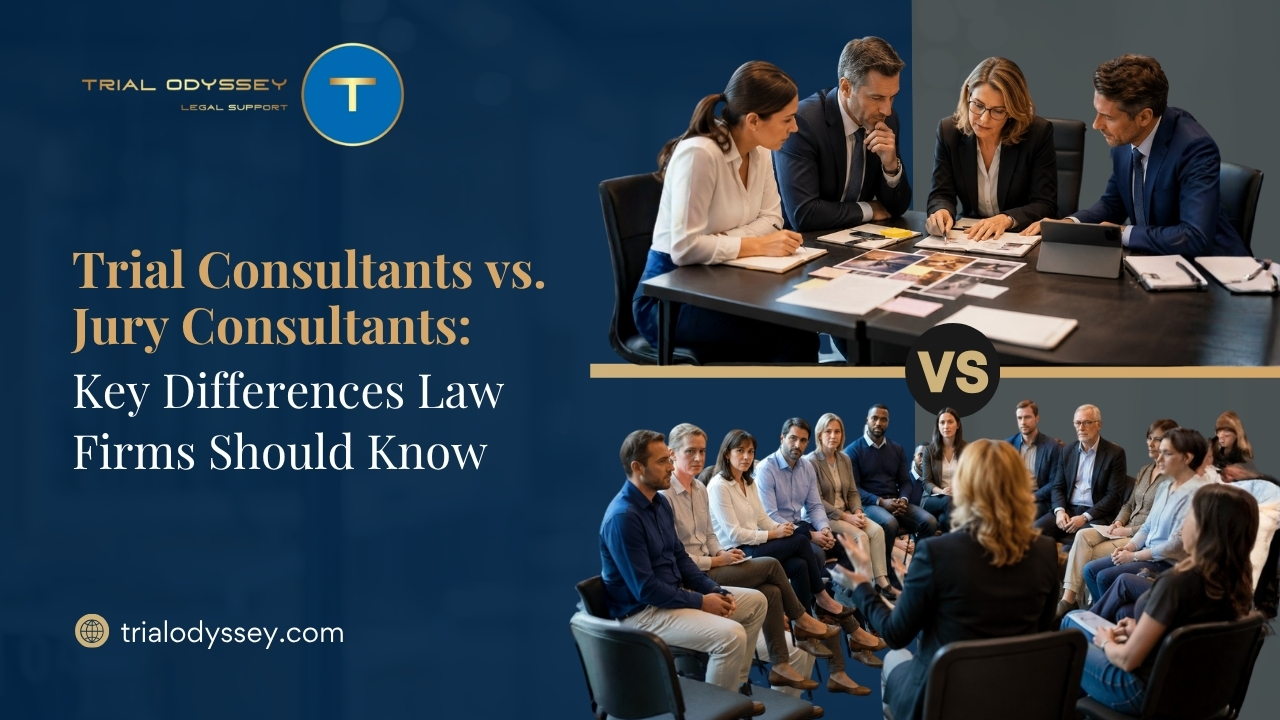
In high-stakes litigation, an attorney’s mastery of statutory law and judicial precedent is only half the battle. The other half is mastering human persuasion. When a complex case stands before a judge or jury, the narrative must be perfectly tuned to how laypeople process information, manage attention spans, and resolve competing facts. To gain an edge, modern law firms routinely look outside their internal staff to partner with behavioral science and litigation specialists.
However, as firms budget for these valuable resources, a common point of confusion arises around industry terminology. Are trial consultants and jury consultants the same thing? While the terms are frequently used interchangeably by the media and even some litigators, they represent distinct operational scopes. Understanding the differences between these roles ensures your firm deploys the right expertise at the right phase of the litigation lifecycle.
What is a Jury Consultant?
Historically, the litigation consulting field began with a narrow focus on the rigid process, the assembly of potential jurors. A traditional jury consultant is a behavioral specialist, typically a social psychologist or sociologist, who focuses primarily on the human dynamics inside the jury box. Their core mandate centers on predicting how specific demographics, personal background traits, and psychological profiles will react to a specific case narrative.
The primary realm of jury consultants is voir dire. Under standard state civil procedures and Federal Rule of Civil Procedure 47, the court permits attorneys to examine prospective jurors to uncover implicit biases. These specialists design supplementary juror questionnaires, analyze public social media footprints in real time during selection, and observe non-verbal body language to advise counsel on when to execute peremptory challenges or strikes for cause.
Defining the Expansion: What is a Trial Consultant?
As the litigation landscape grew more sophisticated, law firms realized they needed scientific perspective on elements of a case that extended far beyond picking twelve people. This operational evolution birthed the broader category of trial consultants. A trial consultant handles a comprehensive, end-to-end suite of litigation support services. While they are fully capable of executing jury selection, their broader responsibilities encompass the entire strategic presentation of the dispute.
These consultants look at the entire courtroom ecosystem. They analyze venue risks through community attitude surveys, run complex mock trials, restructure dry technical data into interactive demonstrative graphics, and coach witnesses to withstand intense cross-examination. In essence, if a jury consultant specializes in who hears the story, a trial consultant specializes in how the entire story is told from the opening statement to the final verdict.
Trial Consultants vs. Jury Consultants
To help your firm maximize its litigation budget, read how these two roles diverge across critical operational categories.
- Chronological Engagement and Timing
A jury consultant is typically retained closer to the trial date, often stepping in during the final weeks of pre-trial prep to focus directly on the jury pool. Conversely, trial consultants are most effective when onboarded early in the discovery phase. Engaging them early allows them to run pre-trial focus groups while discovery is still open, giving your firm the opportunity to adjust its deposition strategies based on early empirical data.
- Witness Preparation and Communication Coaching
While both professionals understand human behavior, their approaches to witness preparation differ. A jury-focused specialist evaluates how a witness’s demographic or perceived personality will play to the specific jury panel. A trial-focused consultant dives deeply into communication mechanics. They analyze audio-visual elements, teach corporate executives how to control nervous physical tells, and ensure expert witnesses explain complex proprietary data without sounding condescending to the bench or box.
- Demonstrative Evidence and Multimedia Strategy
Traditional jury consulting rarely handles hardware or media production. Comprehensive trial consulting firms, however, routinely feature in-house multimedia divisions. Under Federal Rule of Evidence Rule 1006, teams are permitted to present complex summary charts to clarify voluminous records. A trial consultant bridges the gap between the law and visual learning, turning a dry spreadsheet into a crisp, interactive timeline that keeps the room focused.
- Relevance in Bench Trials
If your firm is facing a bench trial before a single federal or state judge, a traditional jury consultant has limited utility because there is no panel to select. A trial consultant, however, remains incredibly valuable. Because judges are still human beings susceptible to cognitive fatigue, a trial-focused specialist helps streamline arguments, ensure that opening statements respect the judge’s specific procedural preferences, and structure evidence to counter the opposing side’s narrative cleanly.
How to Determine Which Specialist Your Case Requires
Choosing the right expert is a balancing act based on case complexity, local venue dynamics, and financial stakes.
When to Prioritize Jury Consultants
If your primary concern is an emotionally charged local venue where public bias runs high, a jury specialist is crucial. They are highly effective in cases where success hinges entirely on filtering out deeply entrenched community prejudices during the voir dire process, such as high-profile civil rights suits, localized product liability actions, or criminal trials.
When to Prioritize Trial Consultants
If your case involves dry, highly technical data, such as patent infringement, complex antitrust litigation, or forensic accounting, a trial consultant is the superior choice. You need an expert who can transform complex corporate data into simple, memorable concepts, optimize witness testimony under pressure, and manage the technical presentation of evidence from start to finish.
Conclusion
The terms may sound similar, but confusing the operational differences between trial consultants and jury consultants can leave critical gaps in your courtroom strategy. While a jury specialist provides vital, deep behavioral insights during the high-stakes window of selection, a trial specialist delivers an expansive, cross-functional toolkit designed to refine your entire presentation.
By matching the specific needs of your case to the correct consulting discipline, your law firm can take the guesswork out of litigation, protect your client’s interests, and deliver a polished, persuasive courtroom narrative that maximizes your chances of a winning verdict.
FAQs
Q1. Can a single consulting firm handle both trial and jury consulting services?
Yes. Many modern, full-service litigation support agencies employ multi-disciplinary teams that include both social scientists and courtroom presentation tech experts. This integrated structure allows a law firm to secure comprehensive trial consultants who handle pre-trial focus groups and visual graphics, while simultaneously utilizing specialized jury consultants within the same firm to manage the intricacies of voir dire.
Q2. Are the findings and communications of these consultants protected by legal privilege?
Yes. Under U.S. federal and state jurisdictions, communications and work product generated by litigation consultants are typically protected under the Attorney Work-Product Doctrine (codified in federal matters under FRCP 26(b)(3)). Because these specialists are retained directly by legal counsel to assist in preparing a case for imminent litigation, their research, mock trial reports, and strategic memos are safely insulated from discovery by the opposing side.
Q3. How do community attitude surveys differ between these two consulting roles?
While both professionals utilize community surveys, they analyze the resulting data through different lenses. A jury consultant reviews a survey to isolate specific demographic identifiers and personal values that correlate with bias, helping build an ideal juror profile. A trial consultant analyzes the exact same data to identify which specific case themes, pieces of evidence, or corporate arguments resonate most clearly with the local population.